Remember that you can hold multiple, even conflicting opinions about the same person.
You can admire or be inspired by certain qualities or accomplishments without necessarily agreeing with all of their views.
Yes, even someone as polarizing as Elon Musk. It’s called nuance.
You can pick and choose which ideas to embrace and which ones to ignore.
Stop shutting down conversations by judging the messenger; listen to what’s actually being said.
Sometimes, controversial minds spark the best insights – if you’re open enough to hear them.
This makes me think about Apple's iconic Think Different ad-campaign:
Here's to the crazy ones.
The misfits.
The rebels.
The troublemakers.
The round pegs in the square holes.
The ones who see things differently.
They're not fond of rules, and they have no respect for the status quo.
You can quote them, disagree with them, glorify or vilify them.
About the only thing you can't do is ignore them.
Because they change things.
They push the human race forward.
While some may see them as the crazy ones, we see genius.
Because the people who are crazy enough to think they can change the world, are the ones who do.
I just can't seem to find the right method. I've tried physical notecards, as per Ryan Holiday and Billy Oppenheimer. I found that to be too cumbersome and frustrating, and also had problems with the messiness of it.
I tried the digital version of it through Zettelkasten. Can't fully say why it didn't stick, but somehow basic Apple Notes was easier and more flexible to maintain for me. I've also tried Evernote, Notion and Obsidian, but they're all too complicated and bulky for what I want.
Mymind is interesting, and sort of works better than the other digital tools I've tried. The visual part is an important aspect that many of the other tools don't have good solutions for. It does however go quite far on the visual side, and doesn't feel great when it comes to slightly longer form note-taking.
Other options I've considered is to build out my home page with more sections dedicated to the needs I have (section for quotes, section for short notes-to-self, health, inspiration etc), but it does feel like a bit too large of a task at the moment.
I have fairly heavily used the native Apple Notes the last year. I've always used it, but the last year I've organized and used it a bit more structured. It's really not too bad, and thats why that still is my way of taking most notes.
Maybe all of this searching is in vain, and simply using Apple Notes is the best solution after all? The problem is just that I really prefer having physical files over the "locked in" apple notes in their cloud kind of a thing.
Which takes me back to using my own web page for this, because Kirby structures this stuff exactly how I want it. A folder per entry/thought/post, with a txt file containing the text content, plus all potential assets of relevance to it. Everything neatly collected in a named folder.
They say "write to think", and I think that through writing this post, I've learned that I probably should try out a MVP note-taking system straight on my own homepage using Kirby. 🤔
Note: I forgot to mention that I also tried a commonplace book system too. That definitely worked better than notecards, but I fell back on the fact that I don't really feel it works for me to purely have written words on a paper to compile my thoughts. Too often I want to include graphics.
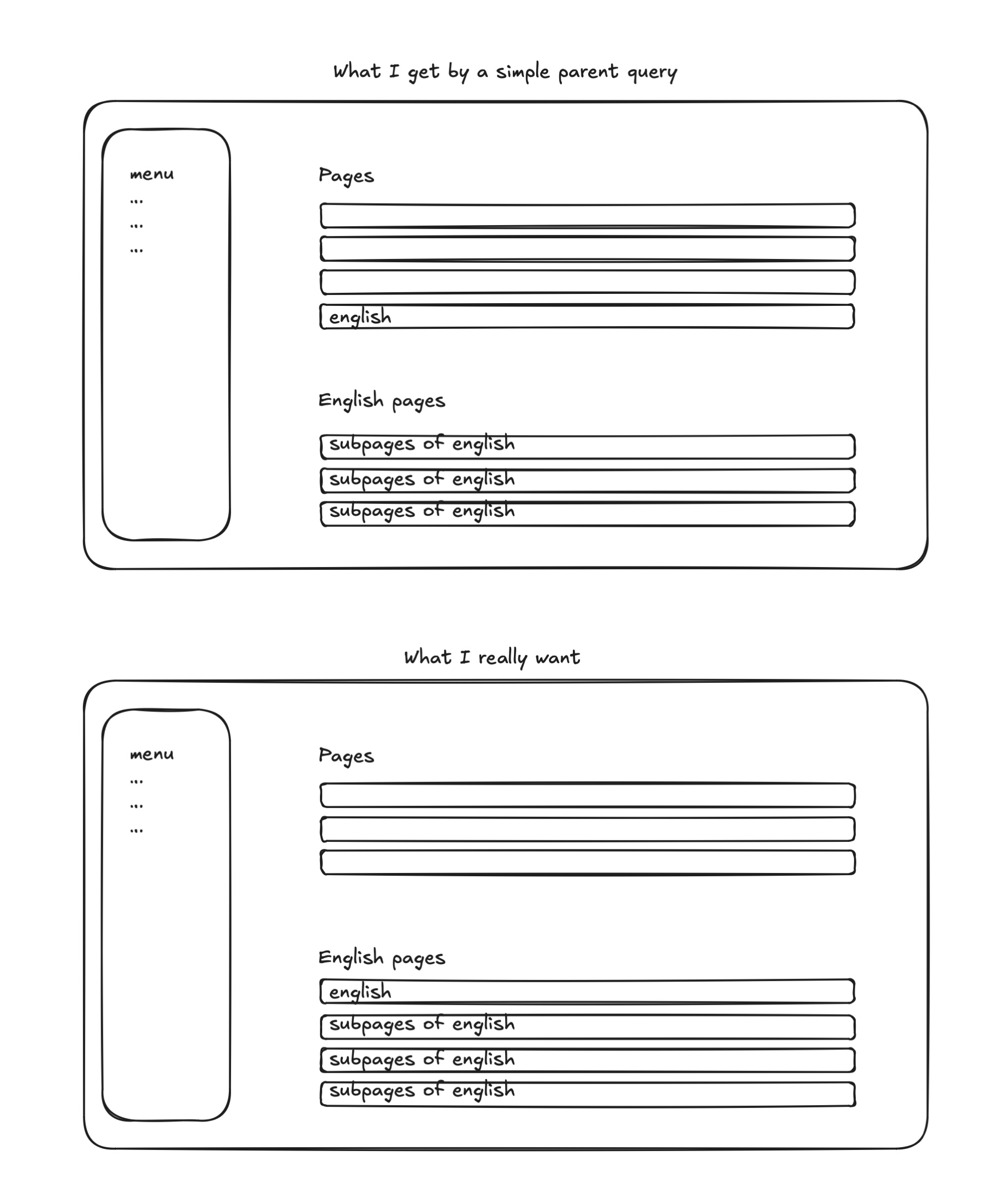
Sometimes I want to display all sub-pages of a certain page together with the parent page in the panel.
An example of this is a basic multi-language setup like 3-5 pages in a native language, plus a couple of english pages also. Some might prefer enabling multilanguage etc. for this, but to me a basic content structure is an easier solution on small pages.
Anyways, this is how I do it with collections.
The easy "out-of-the-box" solution that works well if its a blog, projects, products etc. (a collection or grouping of items) is to just use the parent query. But this of course doesn't include the actual parent which I want in this particular case.
Out of the box I haven't found a simple way to do this, so I use collections for it.
In a collection one can merge multiple queries together, which later can be used in the pages section as a query.
What the heck is up with all the flipping you might ask.
Because in this example, the front page is a single, and the child pages are a collection, I can only add the former to the latter, and not the other way around.
The result is then that the home page ends up at the bottom – which I don't want.
So I first invert the collection, then add the front page to the bottom, then invert the whole thing back. That gives me what I want.
Surely there are more elegant solutions to this, but this is my solution, and it does the job ✌️
Following up on my post from last week, I decided to install Linux on an old 2016 MacBook that was just gathering dust. I installed Ubuntu 24.04 and went through the Omakub installer.
This post will just be a short note-to-self on how to rsync stuff from MacOS to Linux and the other way around locally on my two machines.
Linux to Mac:
Currently on macOS Sonoma (14.6.1)
I needed to go to System settings -> General -> Sharing -> Remote login and turn this on.
To find the local hostname, click on the info-icon next to the "Remote login" lightswitch, and you'll see the host name and how to connect via SSH.
Mac to Linux (Ubuntu 24.04):
You can find your host name by going to Settings -> System -> Secure Shell.
Here one can also flip the light switch to turn it on, but somehow that kept flipping back off after closing settings for me each time.
To actually be able to connect to the Linux from my mac, I needed to install opens-client and openssh-server on it. Running the following did the trick:
At first I started to really consider Linux. Partly because small things annoy me in macOS. Things like not being able to remove animations when switching spaces. But also because I feel stuck in my ways. I've been using Macs for so long that I've become blind to other options out there.
But then my objective voice of reason kicked in, and I didn't see enough compelling reasons to make such a drastic change. But I did want to find out what particularly inspired me with the Omakub project, and take on some of its aspects.
Lazyvim
Sometimes it's hard to pinpoint why something hits a nerve at a given point in time. Vim has been around for ages, and I've always kind of hated it. ssh-ing into a server and trying to do basic stuff like copying one line and pasting it a different spot was a frustration. What's yanking?
Fast forward to 2024, I now see its appeal.
What before just felt foreign, now feels foreign and intriguing.
It appeals to my minimalistic approach to life.
Having less dependencies.
Less computer resources to use.
And LazyVim just made Vim more approachable.
Also, just staying in the terminal feels really nice!
David vs. Goliath
The other aspect that appealed to me from Omakub, was the "us agains the mega corporations" mindset. Whether it's Microsoft, Apple, Google or Amazon.
I keep feeling this urge. An urge to move towards more open standards.
I have a Kindle, but my next e-reader probably won't be from Amazon.
I have an iPhone, but I'm not sure the next phone will be from Apple.
I should be more flexible. Not just settle for what Apple decides to launch.
Sure, these are all potential frustrating changes in the short term. But being more vendor agnostic surely is better in the long-term.
In todays note to self, its just a basic reminder of how to check if a user is logged in or not.
Mainly because I've looked for this at least twice, and got stuck with old forum answers with pre-Kirby v.3 syntax that didn't work.
As with most stuff in Kirby it's very easy once you know how. But sometimes you (me) still get stuck in docs and google searching for small things like this.
if ($kirby->user()) {
/* Do some cool stuff*/
}
Or if you maybe just want to hide the whole page behind a login:
/* in top of the master template file */
<?php if (!$kirby->user()) redirect('/panel') ?>
I use this to be able to make new sections of a page without it being open to the public. For example when I want the client or my coworker to just quickly have a look at it before releasing it.
I also use the redirect solution for working on a WIP-project until it's ready to go live.
There's a term in running called a "kick", which refers to the ability to sprint at the end of an endurance-oriented race.
Often it leads to anger amongst other competitors, who felt it unfair that they had to lead in front the whole race only to be overtaken the last meters.
Yesterday I was watching the final of 1500m running in the Paris Olympic, and Jakob Ingebrigtsen led the race about 1400m out of the 1500m, but ended up forth. Some might say that it was a bad strategic choice, but I believe he knew there were too many other runners in the field with a better kick than himself, so he had to rely on the overall pace of the race. He needed to get rid of the kickers earlier in the race by pushing hard all the way through, to avoid the end sprint.
I'm by no means a professional runner, but from my understanding the value of having a good kick is underestimated.
The Sanity Content Lake is where your content is stored and accessed. It runs in the cloud and is fully managed by us.
What I read: your data is ours, and we control it.
You want to keep the data in your own server you say? Not possible. Do people want it? Yes they do.
Why isn't it possible? Would only be guessing from my side, but data is quite valuable isn't it? And Sanity has investors and surely ambitional growth plans. I can only imagine data ownership being an important factor.
Call me old fashioned, but I'd rather choose where to store my data myself, however fancy and convenient the "lake" is.
Sometimes the database keeps growing and you want to figure out which table(s) are causing the issue. It happens sometimes for me on Craft CMS projects.
I then find it useful to be able to isolate the largest table(s) within the database to see where the issue is at.
I've found the simplest solution being to run the following query:
SELECT tablename AS "Tables", round(((datalength + indexlength) / 1024 / 1024), 2) "Size in MB" FROM informationschema.TABLES WHERE tableschema = "yourdbname" ORDER BY (datalength + index_length) DESC;
I guess a natural follow up question is: Why did you start in the first place?
My thoughts on it:
"Writing to learn": I believe that writing is a great way to learn.
It sorts floating thoughts somewhere. Sure, could be private notes. Could be a physical notepads. Could be voicenotes. But since I make web pages for a living, a simple blog seems like a decent fit.
Practice. Writing is a core skill that never goes out of date, and always will be relevant. And writing a blog practices that writing-muscle.
Learning to let go. Clicking that "publish" button might not mean much. After all, I can probably count on one hand the readers of this post. Still, it feels like a massive hurdle. And because "caring less what others think" is a personal goal of mine, writing and pressing publish aligns well with that. The uncomfort is just proof that I still care too much.
As Steve Jobs said: "You can't connect the dots looking forward; you can only connect them looking backwards. So you have to trust that the dots will somehow connect in your future.". Having some dots written down and timestamped will make it easier for future-you to connect them.
I know, not a great list, but enough to keep me at it for now.
"Writing is easy. You only need to stare at a blank piece of paper until drops of blood form on your forehead"
– Gene Fowler